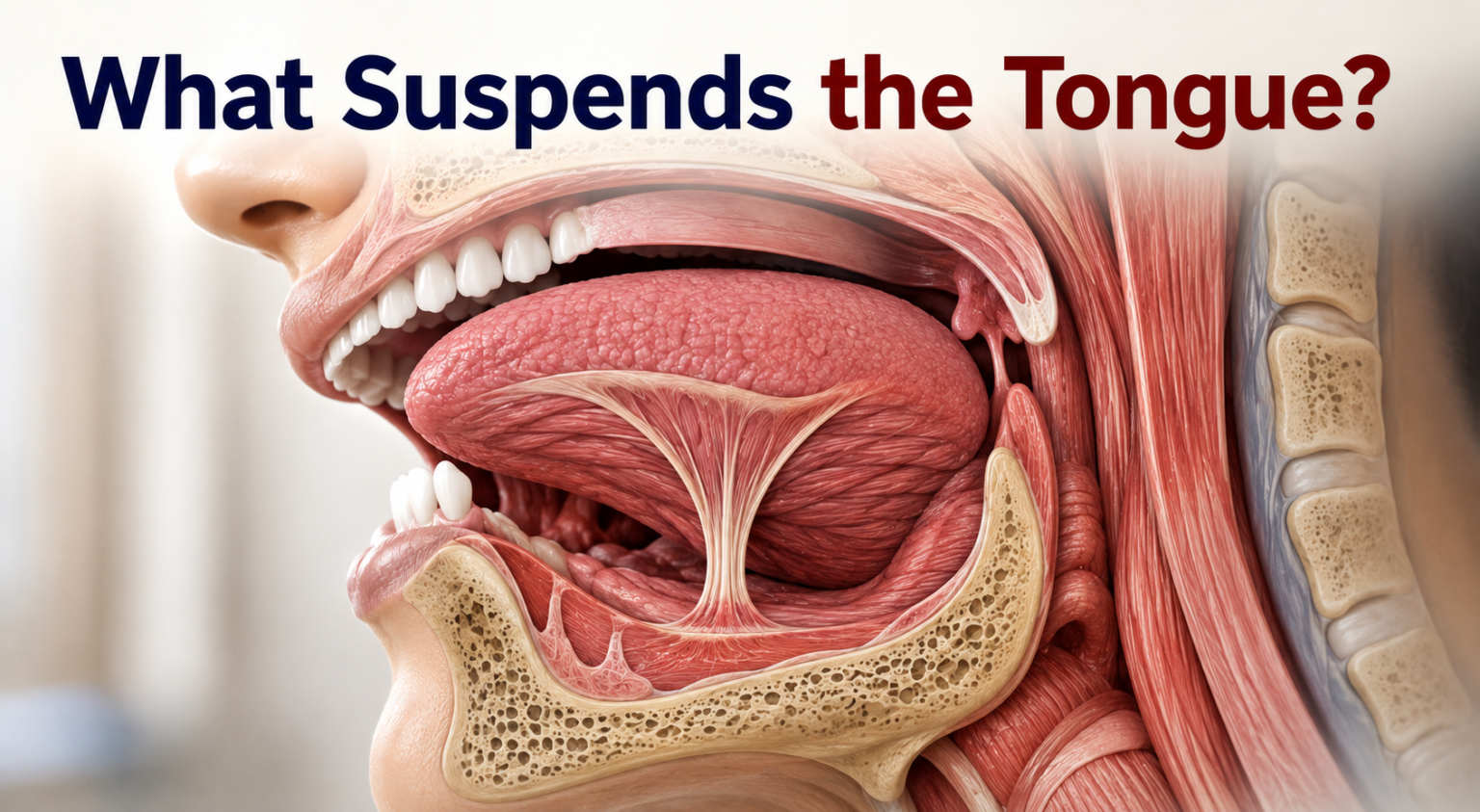
The tongue is one of the most flexible and hardworking organs in the human body, yet very few people stop to think about what actually holds it in place. Unlike many other muscles that sit fixed within a single structure, the tongue is suspended and anchored by a group of muscles that connect it to the jaw, the hyoid bone, the skull, and the soft palate.
If you have ever asked yourself what suspended tongue muscles are responsible for keeping the tongue steady during speech, chewing, and swallowing, the answer lies in a set of four extrinsic muscles working together. These muscles do not just hold the tongue in place; they also control its movement in and out, up and down, and side to side.
This guide breaks down each of these suspending muscles in simple language, explains how they work together, and covers why this anatomy matters for everyday functions like talking and eating. A comparison table is also included to make the differences between each muscle easy to understand at a glance.
Understanding Tongue Anatomy Basics
Before looking at what suspends tongue muscles individually, it helps to understand that the tongue is made up of two different muscle groups. Intrinsic muscles sit entirely within the tongue and are responsible for changing its shape, such as curling or flattening it.
Extrinsic muscles, on the other hand, originate outside the tongue and attach it to nearby bones and structures. It is this second group of extrinsic muscles that suspends the tongue and allows it to move as a whole within the mouth.
The 4 Extrinsic Muscles That Suspend the Tongue
Four extrinsic muscles are directly responsible for suspending the tongue and connecting it to surrounding bone and tissue.
Each one attaches at a different point and contributes a distinct movement, as explained below.
Genioglossus Muscle
The genioglossus originates from the inner surface of the mandible, near the chin, and fans out into the tongue. It is the largest of the four extrinsic muscles and forms the bulk of the tongue’s structure.
Its main job is to protrude the tongue forward and depress its center, which is why it plays a key role in preventing the tongue from falling backward, especially during sleep.
Because of this protective function, weakness in the genioglossus is often linked to airway obstruction issues.
Hyoglossus Muscle
The hyoglossus arises from the hyoid bone, a small U-shaped bone located in the neck that does not connect directly to any other bone.
This muscle pulls the sides of the tongue downward and helps retract it, working opposite to some of the protruding actions of the genioglossus.
It plays an important supporting role during swallowing, helping guide food toward the throat.
Styloglossus Muscle
The styloglossus originates from the styloid process, a small pointed piece of bone located near the base of the skull.
It draws the tongue upward and backward, which is essential for pushing food toward the back of the mouth during the early stages of swallowing.
This muscle works closely with the hyoglossus to control the retraction phase of tongue movement.
Palatoglossus Muscle
The palatoglossus originates from the soft palate at the back of the roof of the mouth, making it the only extrinsic tongue muscle that does not attach to a bone.
It raises the back of the tongue and narrows the opening between the mouth and throat, a movement that assists with swallowing and helps close off the airway briefly.
This muscle is also involved in certain speech sounds that require the back of the tongue to touch the soft palate.
Comparison Table: Extrinsic Tongue Muscles at a Glance
The table below summarizes the origin and main action of each muscle discussed above, making it easier to compare them side by side.
| Muscle | Origin | Main Action |
| Genioglossus | Mandible (chin area) | Protrudes and depresses the tongue |
| Hyoglossus | Hyoid bone | Depresses and retracts the tongue |
| Styloglossus | Styloid process (skull base) | Elevates and retracts the tongue |
| Palatoglossus | Soft palate | Elevates the back of the tongue |
How Do These Muscles Work Together?
None of these four muscles work in isolation. During everyday actions like speaking or swallowing, the brain coordinates all of them at once, adjusting the balance of pull between protrusion, retraction, elevation, and depression.
For example, when you swallow, the styloglossus and hyoglossus draw the tongue backward and downward while the palatoglossus lifts the rear portion to help seal the throat.
When you speak, the genioglossus often takes the lead role in shaping the front of the tongue for different sounds, while the other three muscles make fine adjustments to support pronunciation. This constant teamwork is what makes the tongue such a precise and adaptable organ, despite being suspended by only four muscles.
Why Does Tongue Suspension Matters for Health?
Proper suspension of the tongue is not just an anatomical detail; it directly affects several everyday bodily functions.
The sections below cover three areas where this muscle support plays a noticeable role.
Speech and Articulation
Clear speech depends on the tongue being able to move precisely and return to a stable resting position between sounds.
If the suspending muscles are weak or poorly coordinated, certain consonant and vowel sounds can become difficult to pronounce clearly.
This is why speech therapists often assess tongue muscle strength when evaluating pronunciation difficulties.
Swallowing and Chewing
The tongue plays a central role in moving food around the mouth, positioning it between the teeth, and pushing it toward the throat.
Without properly functioning suspending muscles, food may not be guided efficiently, increasing the risk of choking or inefficient chewing.
This coordination becomes especially important in older adults, where muscle strength naturally tends to decline over time.
Airway and Sleep Function
During sleep, muscle tone throughout the body decreases, including in the tongue.
The genioglossus in particular helps keep the tongue from collapsing backward into the airway, which is a major factor in conditions like snoring and obstructive sleep apnea.
Maintaining healthy tongue muscle tone is one reason some sleep specialists recommend specific tongue and throat exercises.
Common Problems Affecting Tongue Muscles
Several conditions can interfere with how well these muscles suspend and move the tongue.
Two of the most commonly discussed issues are outlined below.
Tongue-Tie (Ankyloglossia)
Tongue-tie occurs when the strip of tissue connecting the tongue to the floor of the mouth is unusually short or tight, restricting movement.
While this involves a different structure than the four extrinsic muscles, it can still limit how freely the tongue moves despite normal muscle function.
In many cases, a simple procedure can release the tissue and restore a fuller range of motion.
Muscle Weakness or Paralysis
Nerve damage, stroke, or certain neurological conditions can weaken or paralyze one or more of the extrinsic tongue muscles.
This can lead to noticeable changes in speech clarity, difficulty swallowing, and in some cases the tongue may deviate to one side when protruded.
Treatment typically depends on the underlying cause and may involve targeted exercises or therapy to rebuild strength where possible.
FAQs
What suspends tongue muscles exactly?
The tongue is suspended by four extrinsic muscles: the genioglossus, hyoglossus, styloglossus, and palatoglossus.
Which muscle is the largest suspending muscle of the tongue?
The genioglossus is the largest and forms most of the tongue’s bulk.
Can weak tongue muscles affect sleep?
Yes, reduced tone in the genioglossus is linked to airway blockage during sleep, including snoring and sleep apnea.
Is tongue-tie related to these four muscles?
No, tongue-tie involves a separate tissue band and does not directly involve the extrinsic muscles discussed here.
Conclusion
Understanding what suspend tongue muscles are and how they function gives a clearer picture of why the tongue can move so freely while still staying anchored in place.
The genioglossus, hyoglossus, styloglossus, and palatoglossus each contribute a unique pull, and together they support speech, chewing, swallowing, and even healthy breathing during sleep.
Recognizing how these muscles work can also help explain why certain speech or swallowing difficulties occur and when professional evaluation may be worthwhile.
RELATED ARTICLES
Can Sciatica Cause Foot Pain? Causes, Symptom, Relief Guide
How Many Bones Are in the Human Foot? Complete Anatomy
What Does a Torn Stomach Muscle Feel Like? Symptoms, Cause