



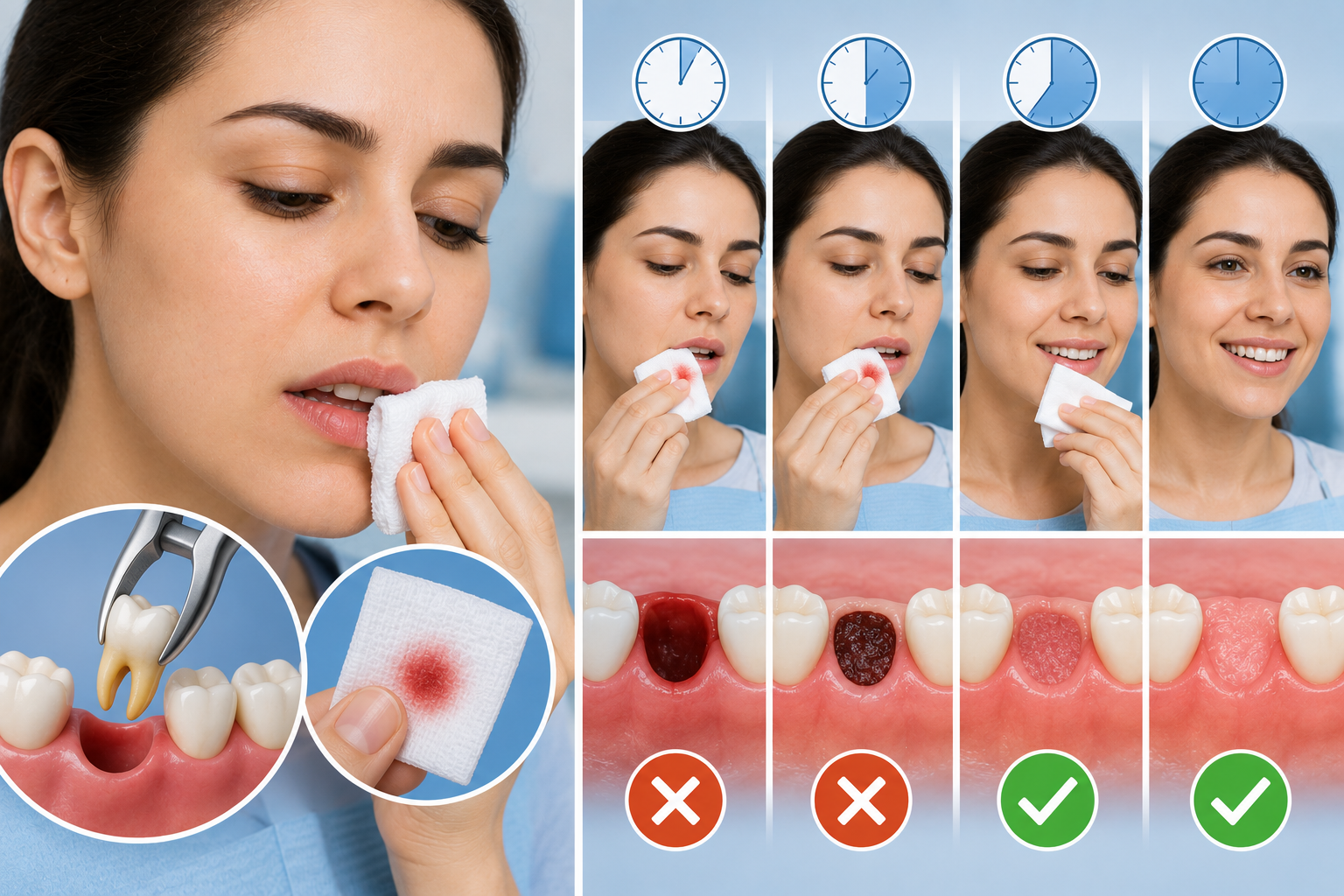
Knowing when to stop using gauze after tooth extraction can feel confusing when you’re staring at a blood-stained pad and no dentist in sight. Most patients worry they’re either removing it too soon or holding onto a soggy pad far longer than they need to. The good news: there’s a clear, predictable timeline most healed sockets follow, plus specific signs that tell you it’s safe to stop. This guide walks through exactly when to remove gauze, what normal healing looks like, and the warning signs that mean you should call your dentist instead.
Key Takeaways
- Most patients can stop using gauze within 2 to 4 hours after a routine extraction, once bleeding slows to a light pink ooze.
- The first gauze pad should stay in place for 30 to 45 minutes with firm, constant biting pressure to let a blood clot form.
- Surgical extractions, including impacted wisdom teeth, often require gauze for 45 to 60 minutes per pad and more changes overall.
- Dry socket affects roughly 1% to 5% of routine extractions, but risk climbs sharply in smokers (Cleveland Clinic, 2025).
- Bright red, pooling blood after 3 to 4 hours is a signal to call your dentist rather than keep changing gauze indefinitely.
The Normal Gauze Timeline After Tooth Extraction
Healing after a tooth extraction follows a fairly predictable pattern, even though every mouth is a little different. Your dentist packs the socket with gauze immediately after the procedure to control bleeding and give a blood clot the chance to form. That clot is the foundation of everything that follows.
First 30 to 45 Minutes: Initial Clot Formation
Bite down gently but firmly on the gauze pad your dentist provides, and keep that pressure steady. Constant pressure — not repeated checking — is what triggers the blood vessels to constrict and start the clotting process. Opening your mouth to peek every few minutes actually slows this down.
1 to 3 Hours: Gauze Changes as Needed
If the pad is still soaked after the first 30 to 45 minutes, replace it with a fresh one and bite down again. Most patients need one to three changes during this window, with fresh gauze roughly every 30 to 60 minutes until bleeding tapers off.
3 to 4 Hours: Bleeding Should Meaningfully Slow
By this point, most routine extractions have moved from active bleeding to a light ooze or none at all. This is generally when patients can stop using gauze after tooth extraction altogether and move into the next phase of recovery.
Pro Tip: Keep your head elevated, even while resting, for the first few hours. Gravity alone can meaningfully reduce how much blood pools at the extraction site.
Signs You’re Ready to Stop Using Gauze
Timing alone isn’t the whole story — the color and amount of fluid on the gauze matters more than the clock. Two patterns show up most often after extraction: active bleeding and normal oozing.
- Bright red, steady blood that keeps soaking through gauze means you’re not ready to stop yet.
- Light pink fluid, closer to diluted saliva than blood, usually signals it’s safe to stop.
- A dry, clean gauze pad after removal is the clearest sign the clot has stabilized.
- Reduced or absent pain compared to the first hour often lines up with reduced bleeding.
Once you remove a pad and see light staining with no fresh pooling, you’re generally at the point where continuing to use gauze does more harm than good — a dry pad stuck to a fragile clot can pull it loose on removal.
How Wisdom Tooth Extraction Changes the Recovery Timeline?
Surgical removal of impacted wisdom teeth involves more tissue disruption than a simple extraction, so the gauze timeline stretches out. Expect pads to need replacing every 45 to 60 minutes rather than 30 to 45, and plan for three or four changes instead of one or two before bleeding controls. Many oral surgeons send patients home with extra gauze specifically because of this longer window.
The underlying rule for wisdom tooth extraction aftercare doesn’t change, though: stop once bleeding has genuinely slowed, not on a fixed schedule and not because you’re impatient to eat something.
What to Do Once You Stop Using Gauze?
Removing the gauze isn’t the finish line — it’s the start of the next healing phase, where protecting the blood clot after tooth extraction becomes the priority.
- Skip rinsing and spitting for the first 24 hours; both can dislodge the clot through suction.
- Avoid straws, smoking, and alcohol, all of which create the same dislodging risk.
- Stick to cool, soft foods — yogurt, smoothies eaten with a spoon, mashed potatoes — for the first day.
- Begin gentle saltwater rinses starting 24 hours after the extraction, several times a day.
- Apply ice for the first 24 to 48 hours, then switch to a warm compress if swelling lingers.
Warning Signs: When You Should NOT Stop Using Gauze
Warning: If bright red bleeding is still soaking through fresh gauze after 3 to 4 hours of consistent pressure, or if blood is pooling rather than oozing, contact your dentist rather than continuing to self-manage at home.
Persistent bleeding can occasionally point to a clotting issue, a missed blood vessel, or simply a socket that needs professional attention. It’s also worth watching for dry socket, a complication where the clot dislodges or dissolves before the wound heals. According to Cleveland Clinic (2025), dry socket occurs in roughly 2% to 5% of extractions overall, though a systematic review published in the journal Dentistry found the rate climbs to around 13.2% in smokers compared with 3.8% in non-smokers.
Dry socket pain typically worsens rather than improves over the days after extraction, often radiating toward the ear or jaw, and it may come with a noticeably unpleasant taste. That pattern — pain getting worse instead of better — is the key difference from normal, gradually improving post-extraction soreness.
Gauze and Aftercare Materials: A Side-by-Side Comparison
🔎 Note on this section: Since this keyword covers dental aftercare rather than a purchasable tool or software category, this comparison covers real aftercare materials and methods instead of a product/pricing table — adapted to stay genuinely useful for a health topic.
| Method | Best For | Typical Duration | Pros | Cons |
| Sterile gauze pad | Immediate post-extraction bleeding control | 30–45 min per pad | Widely available, dentist-recommended standard | Can stick to the clot if left too long |
| Moistened black tea bag | Persistent mild oozing after initial gauze | 20–30 min | Tannic acid may help constrict vessels | Not a substitute for professional care if bleeding is heavy |
| Non-stick (Telfa) pad | Sensitive patients prone to gauze sticking | 30–45 min | Less likely to disturb the clot on removal | Less commonly stocked at home |
Pro Tip: If you switch to a tea bag after initial gauze, use plain black tea (not herbal) and let it cool first — heat can increase bleeding rather than reduce it.
How to Choose the Right Aftercare Approach for Your Situation?
Not every extraction needs the same approach, and choosing correctly depends on a few practical factors.
- Simple, single-tooth extraction: Standard sterile gauze for 2 to 4 hours is usually sufficient.
- Surgical or wisdom tooth extraction: Plan for a longer gauze window and keep extras on hand overnight.
- History of dry socket or slow clotting: Ask your dentist about extended gauze use or a protective dressing before you leave the office.
- Taking blood thinners or birth control: Mention this beforehand, since both can extend bleeding time and change the timeline.
Hypothetical Example (for illustration purposes): Consider a patient who has a single lower molar removed under local anesthesia. Bleeding slows to a light pink ooze by the two-hour mark, so they stop using gauze, avoid rinsing for the rest of the day, and begin gentle saltwater rinses the next morning with no complications. Note: This scenario is illustrative. Actual results vary by individual healing, extraction complexity, and how closely aftercare instructions are followed.
Frequently Asked Questions
Q: When to stop using gauze after tooth extraction?
Most patients can stop once bleeding slows to a light pink ooze, typically within 2 to 4 hours. Surgical extractions may take longer, closer to 3 to 4 hours or more.
Q: What happens if I leave gauze in too long?
A dry, stuck gauze pad can pull the forming blood clot loose when you remove it. This raises the risk of prolonged bleeding or dry socket.
Q: How often should I change the gauze?
Change soaked gauze every 30 to 60 minutes until bleeding noticeably slows. Most people need one to three changes for a routine extraction.
Q: How long after wisdom teeth removal do you stop using gauze?
Wisdom tooth extractions typically need gauze for 3 to 4 hours or longer, with changes every 45 to 60 minutes, since the socket is larger.
Q: Is it normal to still taste blood hours after extraction?
A faint metallic taste from light oozing is normal for the first day. Fresh, bright red blood pooling hours later is not and warrants a call to your dentist.
Q: Can I stop using gauze and switch to a tea bag instead?
Yes, some dentists suggest a moistened black tea bag for mild lingering oozing after the initial gauze period, though it isn’t a substitute for professional evaluation of heavy bleeding.
Q: How do I know if I have dry socket instead of normal healing?
Normal soreness gradually improves; dry socket pain typically worsens a few days in and may radiate toward the ear. Contact your dentist if pain intensifies rather than easing.
Q: When can I stop worrying about the blood clot after tooth extraction?
The clot is most fragile in the first 24 to 72 hours. Most patients can relax about it after the first few days, provided they’ve avoided straws, smoking, and vigorous rinsing.
Conclusion
Most people can stop using gauze after tooth extraction within 2 to 4 hours, once bleeding fades to a light ooze and the pad stays relatively clean.
Watch for bright red, pooling blood beyond that window, since it’s a sign to call your dentist rather than push through alone.
RELATED ARTICLES
Can Allergies Cause Dizziness? Causes, Symptoms, and Relief
What Types of Cancer Qualify for Disability?
5 Reasons to Stop CPR: When and Why It’s Necessary
How to Relieve Neck Pain from Sleeping Wrong: Effective Treatments, Stretches, and Prevention Tips
ASAP Health Max Immune Support Silver Supplement: Benefits, Dosage & Safety Guide