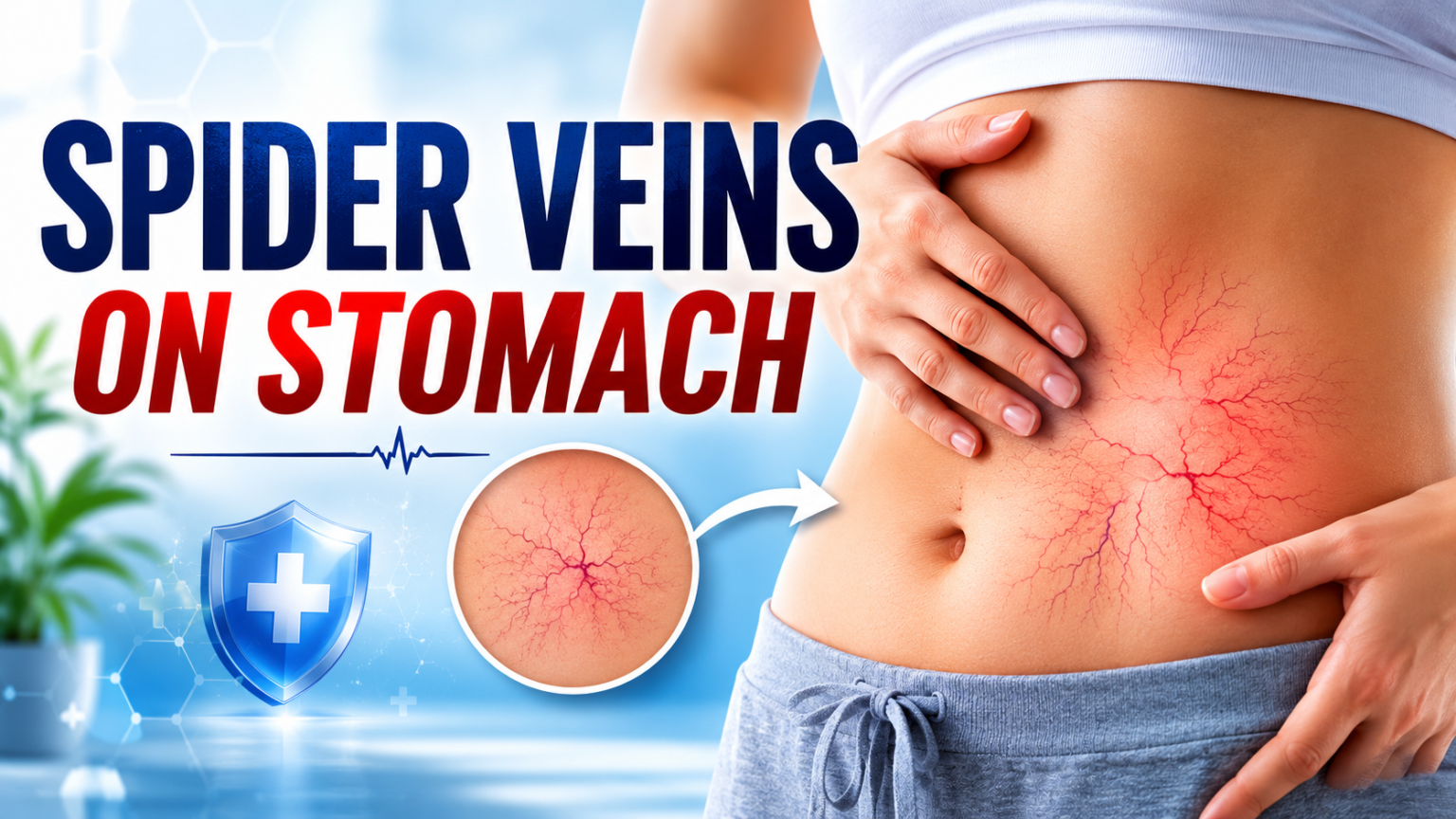
Spider veins on the stomach appear as small, web-like clusters of red, blue, or purple vessels visible just beneath the skin’s surface. For many people, seeing these veins suddenly appear on their abdomen triggers immediate concern — and rightly so, because abdominal spider veins do not always have the same benign explanation as the ones on your legs.
Unlike leg spider veins — which are almost always caused by everyday factors like prolonged standing or heredity — thread veins on the stomach can sometimes signal an underlying circulatory or liver-related condition that deserves medical attention. This guide explains every major cause, helps you identify warning signs, and walks you through all available treatment options so you can make an informed decision.
| 📋 Key Takeaways |
| • Spider veins on the stomach (telangiectasia) are dilated small blood vessels visible under the skin and range from harmless to medically significant. |
| • Pregnancy is one of the most common causes of abdominal spider veins due to increased blood volume and hormonal changes — and they often resolve after birth. |
| • Multiple spider veins spreading from the belly button (caput medusae pattern) can indicate portal hypertension or liver disease and require urgent evaluation. |
| • Red spider angiomas on the upper abdomen or chest carry a 95% accuracy rate for identifying chronic liver disease when several appear together. |
| • Sclerotherapy is the most effective treatment for cosmetic abdominal spider veins, averaging $350–$500 per session according to the American Society of Plastic Surgeons. |
| • Always consult a physician before pursuing cosmetic treatment — ruling out an underlying condition must come first. |
What Are Spider Veins on the Stomach?
Spider veins, medically called telangiectasia, are small blood vessels that have become dilated and are now visible through the skin. On the abdomen, they typically appear as thin red, blue, or purple lines that may form starburst patterns, branching webs, or linear streaks.
Not every visible vein on the abdomen is a spider vein. There are important clinical distinctions:
| Type | Appearance | Common Cause | Concern Level |
| Spider Veins (Telangiectasia) | Fine red/blue web-like lines | Pregnancy, genetics, obesity | Usually low |
| Spider Angioma | Red central dot with radiating vessels | Liver disease, estrogen excess | Moderate to high |
| Caput Medusae | Dilated veins radiating from navel | Portal hypertension, liver cirrhosis | High — urgent |
| Visible Superficial Veins | Distinct blue/green lines | Thin skin, low body fat | Very low |
Understanding which type you have is the critical first step. A fine reddish web near the hip after pregnancy carries a very different meaning than a cluster of veins radiating outward from your navel.
Common Causes of Spider Veins on the Stomach
Abdominal spider veins form for a wide range of reasons. Some are entirely benign; others require medical investigation. Below are the most frequently identified causes.
Pregnancy
Pregnancy is one of the leading causes of stomach veins during pregnancy. As WebMD reports (medically reviewed by Dr. Traci C. Johnson, October 2024), spider veins are a recognized side effect of the significant physiological changes that occur during gestation.
During pregnancy, two major changes drive abdominal vein visibility:
• Blood volume increases substantially, placing added pressure on vein walls throughout the body.
• Elevated estrogen and progesterone levels weaken vein valves, allowing blood to pool in superficial vessels.
Liver Disease and Portal Hypertension
This is the cause that warrants the most attention. When the liver is damaged — due to cirrhosis, chronic hepatitis, or heavy alcohol use — blood flow through the portal vein becomes obstructed. Pressure builds, and blood is rerouted through superficial abdominal veins.
The Cleveland Clinic notes that caput medusae — a distinctive pattern of veins radiating from the navel — is a hallmark sign of portal hypertension. Left untreated, portal hypertension can progress to life-threatening complications including hepatopulmonary syndrome and hepatorenal syndrome.
Genetics and Heredity
Heredity plays a substantial role in vein health. Research cited by Vein Centers of Long Island suggests that if both parents have vein problems, the likelihood of developing them yourself approaches 90%. Genetic predisposition affects how strong your vein walls and valves are from birth.
Obesity and Elevated Abdominal Pressure
Excess body weight increases intra-abdominal pressure, which forces blood into superficial veins. Over time, this sustained pressure causes those small vessels to dilate and become visible. Obesity is also associated with spider angioma formation independently of liver function.
Prior Abdominal Surgery
Surgical procedures involving the abdomen can disrupt normal venous pathways. As scar tissue forms, the body may develop collateral circulation — new vein routes that become visible through the skin. This is more likely after major procedures such as bowel surgery, cesarean sections, or hernia repairs.
Thin Skin and Low Body Fat
In some individuals, particularly those who are lean or older, veins simply become more visible due to reduced subcutaneous fat and thinner skin. These veins are structurally normal — they have not dilated or been damaged — and require no treatment unless cosmetically bothersome.
When Are Spider Veins on the Belly a Warning Sign?
Most spider veins on the belly are cosmetic. However, certain presentations should prompt immediate medical evaluation. The critical distinction often lies in the pattern, color, and accompanying symptoms.
Signs That Require Urgent Medical Attention
Seek care promptly if you notice any of the following alongside your abdominal veins:
• Veins radiating outward from the belly button in a spoke-like pattern (caput medusae).
• Red spider angiomas on the upper abdomen, chest, or face — especially multiple lesions.
• Abdominal distension or a feeling of fullness even when not eating much.
• Yellowing of the skin or eyes (jaundice), dark-colored urine, or pale stools.
• Sudden swelling or warmth in one area of the abdomen.
According to the Cleveland Clinic, a healthcare provider can determine the source of abdominal vein dilation using an abdominal ultrasound — checking which direction blood is flowing. Downward flow toward the legs typically indicates cirrhosis; upward flow toward the heart may suggest inferior vena cava syndrome.
Signs That Are Likely Benign
• Fine, web-like red or blue lines appearing during or after pregnancy.
• Isolated thread veins near the hip, flank, or lower abdomen with no other symptoms.
• Vein visibility that increases with exercise or heat and fades at rest.
• Veins present since childhood or adolescence with no recent change in size.
Treatment Options for Abdominal Spider Veins
Treatment for varicose veins on the abdomen depends entirely on the underlying cause. If liver disease or portal hypertension is present, that condition must be treated first. For cosmetically motivated treatment of benign spider veins, several effective options exist.
Sclerotherapy — Most Effective Cosmetic Option
Sclerotherapy involves injecting a chemical solution — called a sclerosant — directly into the affected vein. The vein walls collapse, the vessel is sealed, and blood is rerouted to healthier vessels. Over several weeks, the treated vein fades and is absorbed by the body.
Key facts about sclerotherapy for stomach spider veins:
• Minimally invasive — performed in a clinic with no general anesthesia required.
• Effective for larger abdominal veins that laser cannot reach.
• According to the American Society of Plastic Surgeons, the average session cost is approximately $500, though some clinics report session fees as low as $350.
• Most patients need one to four sessions for complete clearance.
Laser Treatment — Best for Tiny Surface Veins
Laser therapy uses focused light energy to heat and destroy the targeted vein without breaking the skin. It is most effective for very fine, superficial vessels under 3 mm in diameter. For larger abdominal veins, sclerotherapy typically produces superior results.
According to Healthline, one laser treatment session in the United States typically costs $300 to $600, and patients may need one to six sessions depending on the extent of the veins.
Radiofrequency Ablation — For Associated Venous Insufficiency
If spider veins on the abdomen are caused by underlying venous insufficiency rather than a cosmetic surface issue, radiofrequency ablation (RFA) may be recommended. RFA uses heat energy delivered via a thin catheter to close the malfunctioning deeper vein that is feeding the spider veins at the surface.
Lifestyle Modifications — Preventive, Not Curative
No lifestyle change will eliminate existing spider veins, but several measures slow their progression:
• Maintain a healthy body weight to reduce intra-abdominal pressure.
• Avoid prolonged periods of sitting or standing without movement.
• Compression garments can reduce venous pressure, though they are more practical for leg veins.
• Avoid tight clothing that constricts abdominal circulation.
Comparing Spider Vein Treatments: At a Glance
Use this comparison to start the conversation with your vein specialist. Individual suitability depends on the size, location, and cause of your specific veins.
| Treatment | Best For | Avg. Cost/Session | Sessions Needed | Downtime |
| Sclerotherapy | Medium to large abdominal spider veins | $350–$500 | 1–4 | None (same-day return) |
| Laser Therapy | Very fine surface veins under 3 mm | $300–$600 | 1–6 | Minimal |
| Radiofrequency Ablation | Veins tied to venous insufficiency | $1,500–$3,000 | 1 | 1–2 days |
| Lifestyle Changes | Prevention and slowing progression | Free–Low | Ongoing | None |
| Observation Only | Pregnancy-related veins likely to resolve | $0 | N/A | None |
What Type of Doctor Treats Spider Veins on the Stomach?
Choosing the right specialist depends on your specific situation. Here is a practical guide:
| Specialist | When to See Them | What They Assess or Treat |
| Primary Care Physician | First point of contact for any new abdominal veins | Initial evaluation, blood work, referrals |
| Vascular Surgeon | Complex vein patterns or circulatory concerns | Caput medusae, venous insufficiency, DVT |
| Hepatologist / Gastroenterologist | Suspected liver disease or portal hypertension | Liver function, cirrhosis, esophageal varices |
| Dermatologist | Cosmetic concern, no systemic symptoms | Surface spider veins, sclerotherapy, laser |
| Phlebologist (Vein Specialist) | Dedicated vein care for cosmetic or functional cases | Full vein assessment, sclerotherapy, RFA |
If you have any doubt about the cause of your abdominal veins, start with your primary care physician for bloodwork and a referral. Do not self-refer to a cosmetic clinic without first ruling out systemic causes.
Frequently Asked Questions
What causes spider veins on the stomach?
Abdominal spider veins are most commonly caused by pregnancy, genetic predisposition, obesity, prior abdominal surgery, or liver-related conditions such as cirrhosis and portal hypertension. In thin individuals, veins may simply be more visible due to reduced subcutaneous fat. A physician evaluation is needed to determine which cause applies in your case.
Are spider veins on the stomach dangerous?
Most isolated spider veins on the stomach are not dangerous and are primarily a cosmetic concern. However, multiple spider angiomas — particularly the red, star-shaped type — carry a 95% accuracy rate for identifying chronic liver disease when several appear together. Any abdominal spider veins accompanied by swelling, jaundice, or fatigue warrant urgent medical evaluation.
Can pregnancy cause spider veins on the belly?
Yes. Pregnancy is one of the most common triggers for abdominal spider veins. Increased blood volume, elevated estrogen and progesterone levels, and direct pressure from the growing uterus all contribute. According to available data, approximately 60% of pregnant women develop spider angiomas. Most resolve on their own within months of delivery.
How do I get rid of spider veins on my abdomen?
The most effective treatment is sclerotherapy — a minimally invasive injection procedure that collapses the affected vein. Laser therapy works well for very fine surface veins. Before pursuing any cosmetic treatment, you must first consult a physician to rule out an underlying medical condition as the cause.
When should I see a doctor about veins on my stomach?
See a doctor immediately if your abdominal veins form a spoke-like pattern around the navel, are accompanied by abdominal swelling, yellowing skin, dark urine, or fever. See a doctor soon if the veins appear suddenly without an obvious cause such as recent pregnancy. For veins that have been present for years without change and with no other symptoms, a routine consultation is appropriate.
Conclusion
Spider veins on the stomach range from completely harmless post-pregnancy changes to medically significant signs of liver or circulatory disease. Understanding the pattern, color, and accompanying symptoms of your abdominal spider veins is the essential first step toward the right response.
If your veins are cosmetic and medically cleared, today’s treatments — especially sclerotherapy — deliver excellent results with minimal downtime. If there is any uncertainty about the cause, prioritize a physician evaluation above all else.
Related Articles
Is Muscle Twitching Dangerous? What Your Body Is Really Trying to Tell You
Pain in Ear After Wisdom Tooth Removal: Causes, Relief & When to Worry
Can an Ear Infection Cause Jaw Pain? Causes, Symptoms & Relief
Does Tennis Elbow Cause Shoulder Pain? Causes, Symptoms, Treatment & Prevention Guide