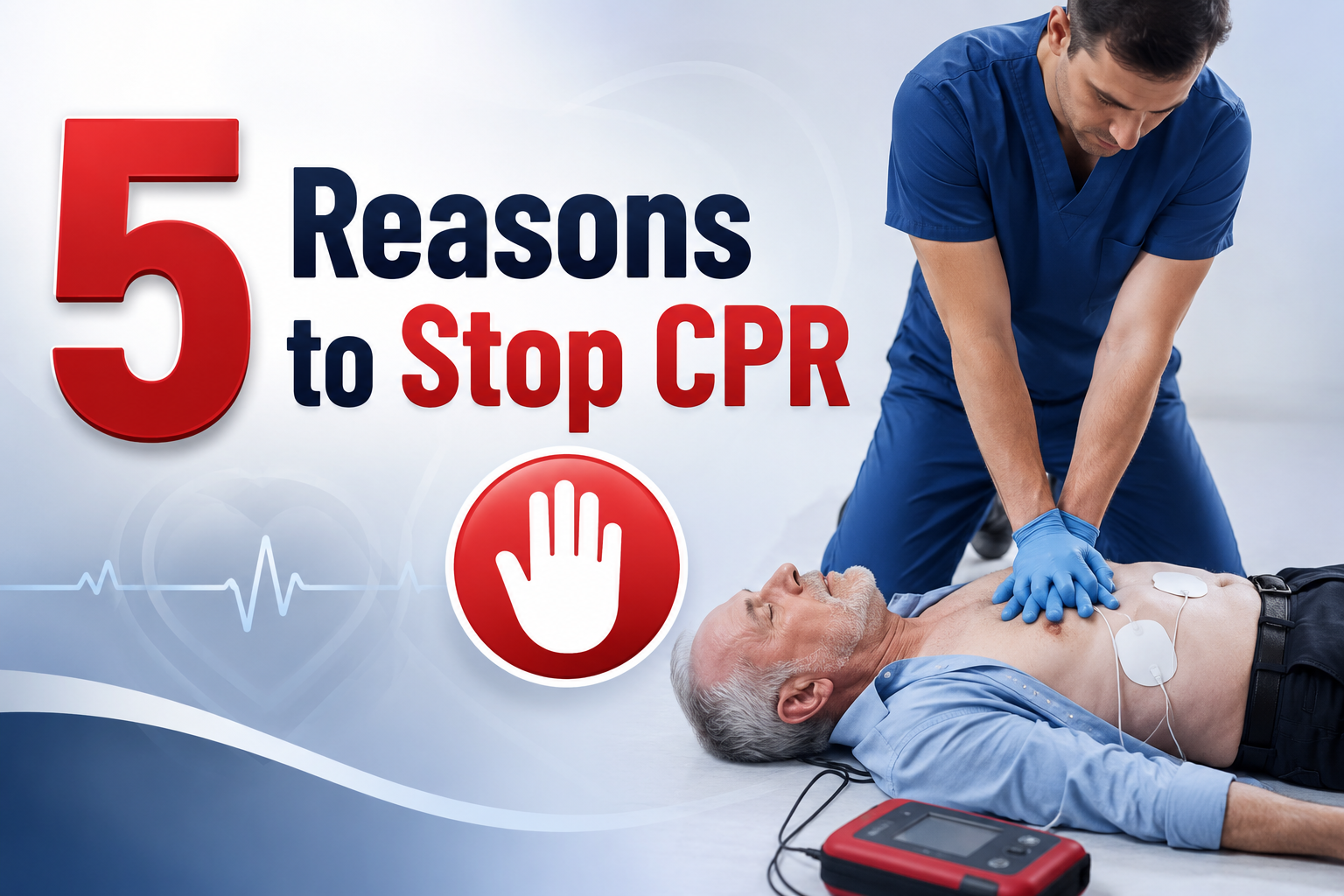
There are 5 reasons to stop CPR, and every rescuer should know all five before an emergency happens. Most people who start chest compressions freeze the moment they consider stopping, worried that letting go means giving up on the person in front of them. That fear is understandable, but stopping at the right moment is often the correct medical decision, not a failure.
This guide walks through each of the five recognized stopping points recognized by resuscitation organizations like the American Heart Association and American Red Cross, explains what each one looks like in real life, and shows you exactly what to do next. By the end, you will know the difference between quitting too soon and stopping for a legitimate, defensible reason.
| Key TakeawaysCPR should continue until one of five specific conditions is met — not simply until you feel unsure or tired.The person showing signs of life, such as breathing or movement, is the clearest reason to stop and reassess.An AED becoming available or trained help (EMS, a nurse, a lifeguard) taking over does not mean you failed — it means the handoff worked.Rescuer exhaustion is a medically recognized reason to stop, especially if no one else can take over compressions.A valid DNR order or a declaration of death by a physician or EMS provider legally ends the resuscitation attempt.Stopping CPR too early, before any of these five conditions apply, meaningfully lowers a person’s chance of survival. |
What Does It Mean to “Stop CPR”?
Stopping CPR means pausing or permanently ending chest compressions and rescue breaths during a cardiac arrest response. It is different from a brief pause to check a pulse or let an AED analyze the heart’s rhythm, which are normal parts of the standard CPR sequence taught by the American Heart Association.
CPR cessation guidelines exist precisely because rescuers should not have to guess. Instead of relying on instinct alone, trained responders and bystanders both follow the same five-condition framework, which removes emotion from a split-second decision.
| Pro TipIf you are ever unsure whether a condition has been met, the safer default is almost always to keep going until EMS arrives and formally takes over. |
Reason 1: The Person Shows Signs of Life (ROSC)
The first and most encouraging reason to stop is return of spontaneous circulation, often shortened to ROSC. This happens when the heart starts beating on its own again.
Watch for these signs that the person’s own circulation has returned:
● Normal breathing resumes, or the person starts coughing or gagging.
● Movement returns, such as an arm twitching or the eyes opening.
● Skin color visibly improves, moving away from pale or bluish tones.
● A pulse becomes detectable at the neck or wrist.
According to the American Heart Association’s BLS guidelines, once ROSC occurs, the rescuer should stop compressions but stay with the person, monitor their breathing closely, and be ready to resume CPR immediately if the person stops breathing again.
Reason 2: An AED or Trained Rescuer Takes Over
The second reason to stop is a handoff, not a retreat. This applies the moment an automated external defibrillator (AED) is ready to analyze the heart rhythm, or when EMS, a paramedic, a nurse, or another trained rescuer arrives and takes responsibility for care.
Why Handing Off Is Not Giving Up
Continuing to perform compressions while an AED tries to read the heart’s rhythm will produce an inaccurate reading and delay a potentially life-saving shock. The American Red Cross instructs rescuers to stand clear the moment the AED begins analysis, and to resume compressions immediately if no shock is advised.
| WarningNever delay attaching an AED because compressions feel like they are working. Early defibrillation, when a shockable rhythm is present, is one of the strongest predictors of survival in sudden cardiac arrest. |
Reason 3: The Scene Becomes Unsafe
Rescuer safety comes before patient care in every first aid curriculum. If the environment turns dangerous, that is a valid reason to stop CPR immediately and move to safety.
Common examples of an unsafe scene include:
● Fire, smoke, or a gas leak develops near the person.
● A structure becomes unstable, such as during an earthquake aftershock.
● Traffic or moving vehicles put the rescuer at risk on a road or highway.
● A violent individual or an active threat is present at the scene.
If it is safe to do so, move the person to a secure location before resuming CPR. If it is not safe, retreat first and call for emergency help — you cannot help anyone if you become a second casualty.
Reason 4: You Are Too Exhausted to Continue
High-quality chest compressions are physically demanding, and fatigue sets in faster than most people expect. Rescuer exhaustion is one of the reasons to discontinue CPR that trained responders are specifically taught to recognize in themselves and in each other.
This is exactly why CPR-certified courses teach switching rescuers every two minutes whenever a second trained person is present, since compression quality drops noticeably as fatigue builds.
| Hypothetical Example (for illustration purposes):A bystander performs solo CPR on a stranger for close to fifteen minutes while waiting for an ambulance in a remote area. By the ten-minute mark, their compressions have become shallow and inconsistent because their arms are giving out. Recognizing this, they briefly pause, shake out their arms, and immediately resume at full depth rather than continuing with weak, ineffective compressions.Note: This scenario is illustrative. Actual results vary by rescuer fitness, environment, and time until EMS arrival. |
Reason 5: A Physician or Valid DNR Order Ends Resuscitation
The final reason covers the legal and clinical side of when can you legally stop CPR. This applies in two main situations.
A Do-Not-Resuscitate (DNR) Order Is Presented
If a valid, verifiable DNR order is shown to rescuers before or during CPR, they should stop resuscitation efforts and follow the order, in line with state-level advance directive laws.
A Physician or EMS Provider Pronounces Death
Only a physician, or an EMS provider following medical protocol and often in contact with a physician by radio or phone, has the authority to pronounce someone dead and end resuscitation efforts in the field. A bystander should never make this determination alone.
The 5 Reasons to Stop CPR at a Glance
Use this quick-reference table when you need to compare the five conditions side by side.
| Reason | What It Looks Like | What to Do Next |
| Signs of life (ROSC) | Breathing, movement, or pulse returns | Stop compressions, monitor closely, stay ready to resume |
| AED or trained help arrives | AED ready to analyze, or EMS/nurse takes over | Stand clear for AED, or hand off care formally |
| Scene becomes unsafe | Fire, traffic, violence, or structural danger | Move to safety first, resume only if safe |
| Rescuer exhaustion | Compressions become shallow or inconsistent | Switch rescuers if possible, or briefly reset form |
| DNR or pronouncement of death | Valid DNR shown, or physician/EMS declares death | Stop resuscitation and follow legal directive |
How Long Should You Perform CPR Before Stopping?
There is no fixed time limit written into CPR cessation guidelines. Rescuers are trained to continue until one of the five conditions above occurs, not until a specific number of minutes has passed.
In practice, this often means performing CPR for well over ten minutes in areas with longer ambulance response times. The National Institutes of Health notes that survival outcomes are closely tied to how quickly high-quality compressions and defibrillation begin, which is part of why rescuers are taught to keep going rather than stop based on a guess about how long is “enough.”
Common Mistakes People Make When Stopping CPR Too Soon
Even well-meaning rescuers sometimes stop for reasons that do not meet any of the five accepted conditions. Watch for these mistakes:
● Stopping because the person’s ribs crack or make a sound — this is a normal, expected part of effective compressions and is not a reason to stop.
● Stopping because compressions do not seem to be “working” within the first few minutes — cardiac arrest recovery is rarely immediate.
● Stopping because bystanders discourage continuing — only a physician, EMS provider, or valid DNR can end the effort.
● Stopping because the rescuer assumes someone else already called 911 — always confirm emergency services are actually on the way.
| WarningFeeling or hearing a rib fracture during compressions is common and expected. It is not, on its own, a medical reason to stop CPR. |
Frequently Asked Questions
Q: What are the 5 reasons to stop CPR?
The five reasons are: the person shows signs of life (ROSC), an AED or trained rescuer takes over, the scene becomes unsafe, the rescuer becomes too exhausted to continue, and a physician or valid DNR order ends the attempt.
Q: Can you legally stop CPR once you start?
Yes. Once you begin, you are generally expected to continue until one of the five recognized conditions is met, unless a valid DNR order is presented or a physician or EMS provider pronounces death.
Q: What are 4 conditions to stop CPR?
Some courses group the five reasons into four broader categories: signs of life returning, handoff to an AED or trained help, an unsafe scene, and rescuer exhaustion, with legal pronouncement of death sometimes folded into the handoff category.
Q: When should CPR be stopped according to the AHA?
The American Heart Association teaches stopping when ROSC occurs, when an AED or advanced provider takes over, when the scene becomes unsafe, when the rescuer is physically unable to continue, or when a physician declares death.
Q: Do you stop CPR if you feel ribs break?
No. Rib fractures and cracking sounds are a common, expected part of properly performed compressions and are not, by themselves, a reason to stop.
Q: How long should CPR be performed before stopping?
There is no set time limit. Rescuers continue performing CPR until signs of life return, trained help takes over, the scene becomes unsafe, exhaustion prevents effective compressions, or a physician pronounces death.
Q: What happens if you stop CPR too early?
Stopping before one of the five recognized conditions is met reduces the person’s chances of survival, since interrupted blood flow to the brain and heart can quickly become irreversible.
Final Thoughts
Knowing the 5 reasons to stop CPR turns a moment of panic into a clear, confident decision. Whether it’s signs of life returning, a trained rescuer stepping in, an unsafe scene, physical exhaustion, or a legal pronouncement of death, each condition protects both the patient and the rescuer.
Stopping for the right reason is never giving up — it’s following the same standard every trained responder relies on.
If you haven’t taken a hands-on CPR course yet, consider enrolling in basic life support training so you can practice these decisions under supervision before a real emergency happens.
Related Posts
Can Allergies Cause Dizziness? Causes, Symptoms, and Relief
How Long Does a Sore Throat From Allergies Last?
What Types of Cancer Qualify for Disability?
Pain in Ear After Wisdom Tooth Removal: Causes, Relief & When to Worry
What Is Optimal Health? A Complete Guide to Physical, Mental, and Emotional Wellness