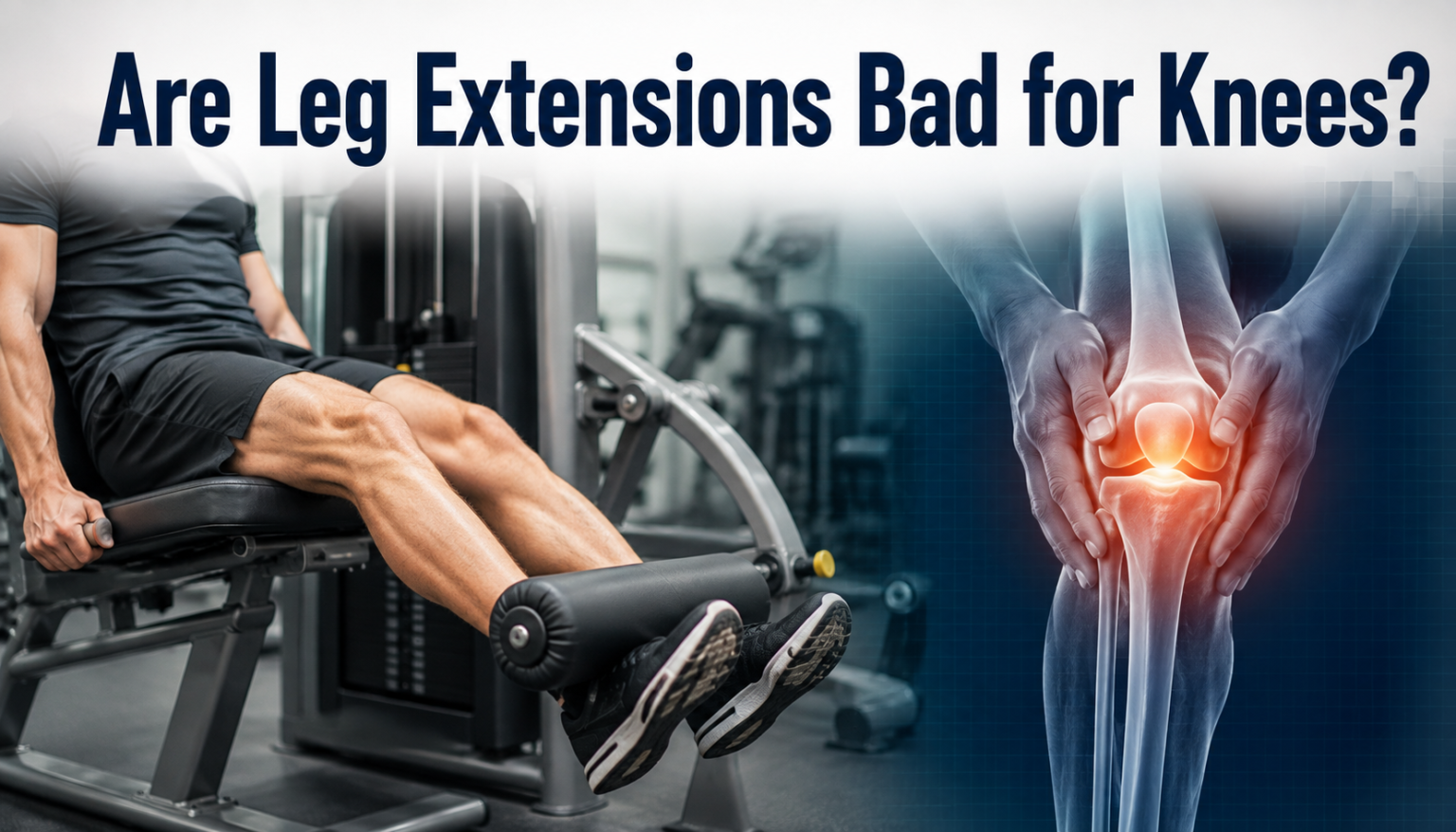
Leg extensions are not bad for your knees, and for people with healthy joints, they are one of the safest isolation exercises you can add to a lower-body routine. The confusion around this exercise mostly comes from outdated gym myths that link open-chain movements to automatic joint damage, which biomechanical research does not support.
Studies comparing leg extensions to squats and leg presses have found that knee stress from this machine falls within a normal, tolerable range for most healthy individuals. Problems only tend to appear when someone already has patellar tendon irritation, cartilage damage, or arthritis, or when the exercise is performed with poor form and excessive load.
Understanding your own knee history and using the machine correctly matters far more than avoiding it altogether. The sections below break down exactly what the science says and how to protect your knees while still building quad strength.
Key Takeaways
- Leg extensions are safe for most healthy knees when performed with controlled form and reasonable weight.
- Research shows knee joint stress during leg extensions is comparable to, and sometimes lower than, stress produced by squats.
- People with patellar tendinopathy, cartilage damage, or arthritis should modify or avoid the exercise based on professional guidance.
- Poor machine setup, heavy loads, and forceful lockouts are the real causes of knee discomfort, not the exercise itself.
- A physical therapist or doctor can help you decide if leg extensions fit your specific knee condition.
What Are Leg Extensions and How Do They Work?
Leg extensions are performed on a seated machine that isolates the quadriceps by having you straighten your knee against resistance from a padded lever. Because the movement only happens at the knee joint, it is classified as an open-chain exercise, unlike squats or lunges, which involve multiple joints working together.
The Machine Mechanics
When you sit in the machine, your shin is placed behind a padded bar connected to a weight stack through a lever arm. As you extend your knee, the quadriceps contract to lift the pad, and the resistance increases as your leg approaches full extension. The pivot point of the machine is meant to align with your knee joint, and correct alignment is one of the biggest factors in how much stress the joint actually absorbs during the movement.
Muscles Targeted
The primary muscle worked is the quadriceps group, specifically the rectus femoris, vastus lateralis, vastus medialis, and vastus intermedius. Because the hip is not involved in the movement, leg extensions isolate the quads more directly than compound exercises like squats, which also recruit the glutes, hamstrings, and core. This isolation is exactly why the exercise is popular in both bodybuilding programs and physical therapy settings for targeted quad strengthening.
Do Leg Extensions Actually Damage Healthy Knees?
For people without pre-existing knee conditions, leg extensions do not cause structural damage when performed correctly. The idea that this machine is dangerous largely comes from outdated assumptions rather than current biomechanical evidence.
What Research Says
A 2014 study published in the Journal of Orthopaedic & Sports Physical Therapy compared patellofemoral joint stress between squats and leg extensions in healthy adults and found that squats produced significantly higher joint stress at deeper knee bend angles than leg extensions did at full extension.
Similarly, a 1993 biomechanics study in the American Journal of Sports Medicine, often referenced by Mayo Clinic-affiliated researchers, found that leg extension stress was highest near full extension while leg press stress was highest at deeper flexion angles, meaning neither exercise is universally “safer” across the entire range of motion.
A separate computer-simulation study using cadaveric knee models concluded that open-chain leg extensions did not produce stresses beyond what cartilage can physiologically tolerate, even when compared directly to closed-chain exercises like squats. Together, these findings challenge the long-standing myth that isolating the knee joint automatically means overloading it.
Comparing Leg Extensions to Squats and Lunges
Squats and lunges are closed-chain exercises, meaning your foot stays planted while multiple joints move together, distributing load across the hips, knees, and ankles. Leg extensions concentrate the work at the knee alone. This does not make leg extensions more dangerous; it simply means the type of stress is different. At shallow knee angles, leg extensions can produce higher patellofemoral stress than squats, while at deeper angles, squats tend to produce more stress on the joint. For someone with healthy cartilage, both patterns fall within a normal, adaptable range.
Who Should Be Cautious With Leg Extensions?
While leg extensions are safe for most people, certain knee conditions call for a more careful, individualized approach before adding this exercise to a routine.
Existing Patellar Tendinopathy or Ligament Injuries
If you have an irritated patellar tendon, sometimes called jumper’s knee, the direct pull created during a leg extension can aggravate symptoms, especially near full knee extension where tendon load peaks. Similarly, people recovering from ACL or other ligament injuries are often advised to delay or modify open-chain knee extension work until cleared by a surgeon or physical therapist, since early loading in certain ranges can stress a healing graft.
Post-Surgical or Arthritic Knees
People with patellofemoral arthritis or those recovering from knee surgery may tolerate leg press exercises better than leg extensions in early rehabilitation phases, according to biomechanical comparisons of joint stress across different flexion angles. This does not mean leg extensions are permanently off-limits, but timing and range of motion typically need to be adjusted under clinical guidance.
Signs of Improper Form or Machine Setup
Sharp pain, clicking, or swelling after using the machine often points to setup issues rather than the exercise itself being harmful. A pivot point that does not match your knee joint, a seat positioned too far forward or back, or a starting range that forces excessive stretch can all create unnecessary strain regardless of your underlying joint health.
Common Mistakes That Increase Knee Strain
Most knee discomfort linked to leg extensions traces back to how the exercise is performed rather than the exercise itself.
Excessive Weight Load
Loading the machine with more weight than your quadriceps can control forces your knee joint to absorb the difference. This is one of the fastest ways to turn a low-risk exercise into a painful one, particularly for lifters chasing heavy numbers instead of controlled strength gains.
Fast, Jerky Reps and Forceful Lockout
Swinging the weight up using momentum, rather than a slow and controlled contraction, increases the peak force placed on the patellofemoral joint. Slamming into a hard lockout at the top of the movement adds a sudden jolt of stress that a smooth, controlled rep would otherwise avoid.
Poor Machine Alignment
Every leg extension machine has an adjustable seat and pad designed to line up with your specific knee joint. When the pivot point does not match your anatomy, the lever arm creates uneven torque across the knee, which can lead to discomfort even at moderate weights.
How to Perform Leg Extensions Safely?
Getting the setup and execution right is what separates a knee-friendly exercise from one that causes irritation. The table below compares leg extensions to two common alternatives across the factors people care about most.
| Factor | Leg Extension | Leg Press | Bodyweight Squat |
| Joint type | Open-chain (knee only) | Closed-chain (knee, hip) | Closed-chain (knee, hip, ankle) |
| Peak knee stress angle | Near full extension | Deeper flexion (bent knee) | Deeper flexion (bent knee) |
| Muscle isolation | High (quads only) | Moderate (quads, glutes) | Low (full lower body) |
| Best suited for | Targeted quad strengthening, controlled rehab | General strength, post-surgical phases | Functional strength, daily movement patterns |
| Caution level for arthritic knees | Moderate, adjust range | Often better tolerated | Depends on depth and load |
Proper Setup and Range of Motion
Adjust the seat so your knee lines up with the machine’s pivot point, and set the starting position so your knees bend to roughly 90 degrees. Avoid extending into a hard, locked-out position if you feel any pinching, and instead stop just short of full extension while still contracting the quads fully.
Recommended Rep/Tempo Guidelines
A controlled tempo of about two seconds lifting and three seconds lowering allows your muscles, rather than momentum, to control the load. Most people tolerate this exercise well with moderate weight for 10 to 15 repetitions, prioritizing smooth control over chasing heavier plates.
When to Consult a Physical Therapist or Doctor
If you have a documented knee condition, recent surgery, or persistent pain that shows up specifically during or after leg extensions, it is worth getting a professional assessment before continuing. A physical therapist can also help scale the range of motion or resistance to match your recovery stage.
Alternative Exercises for Sensitive Knees
For people who are not ready for machine-based knee extension work, there are still effective ways to build quad strength without the same joint demands.
Bodyweight and Low-Impact Options
Wall sits, step-ups on a low platform, and straight-leg raises allow you to strengthen the quadriceps with minimal joint compression, making them useful starting points during early rehab or for anyone easing back into training.
Closed-Chain vs. Open-Chain Movements
Closed-chain options like the leg press or partial squats distribute load across multiple joints, which some people with sensitive knees find more comfortable. Choosing between open-chain and closed-chain work often comes down to which specific range of motion causes discomfort for your individual knee.
FAQs
Are leg extensions bad for your knees long term? No, consistent research shows leg extensions do not cause long-term joint damage in people with healthy knees when performed with proper form and reasonable load.
Is leg extension good or bad for knees? It depends on your knee history. For healthy joints, it is a safe and effective isolation exercise; for arthritic or injured knees, it may need modification under professional guidance.
What exercises should I avoid with bad knees? Deep squats, high-impact jumping movements, and heavy leg extensions near full lockout are often the first exercises to modify, though the right approach depends on your specific diagnosis.
Can leg extensions cause knee pain? Poor machine setup, excessive weight, or an existing knee condition can cause discomfort, but the exercise itself is not inherently painful for most healthy users.
Conclusion
Leg extensions are not the knee-damaging exercise gym folklore has made them out to be. For healthy knees, the research consistently shows the exercise falls within a safe stress range, comparable to or sometimes lower than squats depending on the angle of movement.
The real risk factors are excessive weight, poor form, and skipping professional guidance when a pre-existing knee condition is involved. Used correctly, leg extensions remain a valuable tool for building quad strength and supporting knee rehabilitation.
RELATED POSTS
Can Allergies Cause Chest Tightness? Causes, Symptoms
Can Bad Posture Cause Chest Pain? Causes, Symptoms & Relief
How to Fix Peeling Skin on Feet: Causes, & Prevention Tips
Car Accident Back Pain: Causes, Symptoms, and Treatment Options
Deep Knots in Shoulder Blades: Symptoms, Causes & Relief Tips