



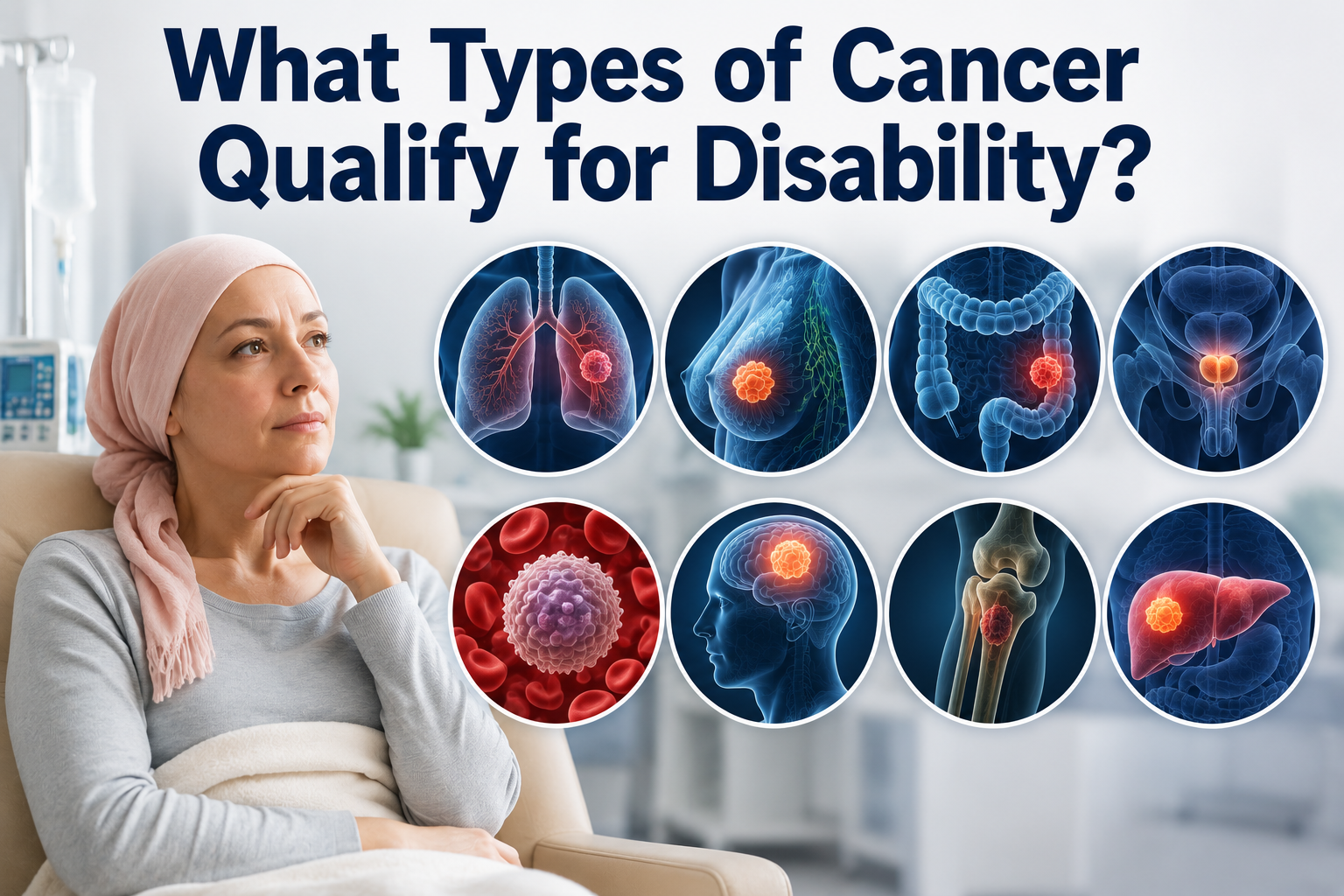
What types of cancer qualify for disability depends on how severe and advanced the diagnosis is — some cancers get approved in days, others take months of documentation. That uncertainty leaves patients and caregivers stuck between treatment appointments and unanswered paperwork, unsure which path their case even falls under.
This guide walks through both routes: the SSA’s Compassionate Allowances list for fast-track cancers, the standard Blue Book Listing 13.00 review for everything else, and exactly how much SSDI or SSI actually pays once a claim is approved.
Key Takeaways
- Certain cancers, such as inoperable pancreatic cancer, small-cell lung cancer, and stage IV cancers with distant metastases, are on the SSA’s Compassionate Allowances (CAL) list and can be approved in as little as 10 days.
- The CAL list currently includes 300 conditions, a large share of them cancer-related, and is updated periodically as new conditions are added.
- Cancers not on the CAL list can still qualify under Blue Book Listing 13.00, which covers 28 separate cancer categories by body system.
- Even a fast-tracked approval does not skip the standard five-month SSDI waiting period — ALS is the only condition exempt from that wait.
- Maximum SSDI benefits reach $4,152 per month in 2026, while maximum SSI is $994 per month, though actual amounts depend on work history and income.
Two Paths to Cancer Disability Approval
Every cancer disability claim moves through one of two tracks at the SSA, and knowing which one applies to your diagnosis changes how fast — and how easily — your claim gets approved.
The first track is Compassionate Allowances (CAL), reserved for cancers considered so severe they obviously meet SSA’s disability standard once diagnosis is confirmed. The second is the standard Blue Book Listing 13.00 review, which requires more detailed documentation of stage, treatment response, and metastasis.
Pro Tip: Ask your oncologist to state your diagnosis using the exact medical terminology SSA uses (for example, “inoperable” or “distant metastases”) in your records. This single detail can be the difference between a CAL match and a lengthy standard review.
Which Cancers Are on the SSA Compassionate Allowances List?
The Compassionate Allowances list is the fastest route to approval, and cancer is one of its largest categories. According to the Social Security Administration, the program now covers roughly 300 conditions, and it continues to expand as new evidence-based additions are made (SSA, 2026).
Cancers commonly included on the CAL list involve distant metastases, or disease that is inoperable, unresectable, or recurrent. Examples pulled directly from SSA’s published list include:
- Adrenal cancer — with distant metastases or inoperable, unresectable, or recurrent disease
- Small-cell (oat cell) lung cancer — automatically qualifying due to its aggressive nature
- Inflammatory breast cancer — a fast-spreading subtype flagged for expedited review
- Esophageal cancer, gallbladder cancer, and liver cancer (hepatocellular carcinoma) — each listed outright
- Acute leukemia and adult non-Hodgkin lymphoma — blood cancers considered automatically severe
Warning: Being on the CAL list does not mean benefits are automatic. The Social Security Administration still requires medical evidence confirming the diagnosis and its severity before approving any claim.
As of April 2026, the SSA added several new cancer-related conditions to the list, including cholangiocarcinoma, metastatic endometrial adenocarcinoma, primary omental cancer, and sarcomatoid carcinoma of the lung (stages II–IV), according to disability law firm coverage of the update (Ortiz Law Firm, 2026). This shows the list is a living document, not a fixed set of diagnoses.
How the SSA Blue Book Evaluates Cancer Under Listing 13.00
If a cancer diagnosis isn’t on the CAL list, it doesn’t mean a claim is hopeless — it means the case goes through Blue Book Listing 13.00, the SSA’s standard cancer evaluation section for adults.
Listing 13.00 breaks cancer into 27–28 subsections by body system, from lung and breast cancer to lymphoma, leukemia, and multiple myeloma. Each subsection lists exact criteria that must be documented, most commonly:
- Metastasis to or beyond regional lymph nodes
- Disease that is inoperable, unresectable, or recurrent after initial treatment
- Small-cell histology, which is treated as automatically severe in several cancer types
- Cancer treated with a bone marrow or stem cell transplant, which is considered disabling for at least 12 months after the procedure
What Happens After Treatment Responds Well?
Cancer that goes into remission for three or more years generally no longer meets a Blue Book listing, according to SSA’s own evaluation rules (SSA, Listing 13.00). After that point, the agency looks instead at lingering effects — nerve damage, fatigue, organ damage — under the body system those effects actually impact.
Cancer Types That Typically Qualify Fastest for SSDI or SSI
Some cancer diagnoses move through the system faster than others simply because their severity is well documented and hard to dispute. Based on SSA’s published CAL and Blue Book criteria, the cancers most likely to see rapid approval share a few traits.
- Stage IV or metastatic cancers — spread beyond the original site to distant organs
- Cancers labeled inoperable or unresectable — meaning surgery is not a viable treatment option
- Aggressive histologies, such as small-cell carcinoma or acute leukemia
- Recurrent cancers — disease that has returned after initial treatment appeared successful
- Cancers requiring bone marrow or stem cell transplant — automatically considered disabling for at least 12 months
Hypothetical Example (for illustration purposes): Consider a 54-year-old warehouse worker diagnosed with inoperable pancreatic cancer. Because this diagnosis appears on the Compassionate Allowances list, her claim is flagged for expedited review, and with pathology reports and oncology notes on file, a determination could realistically be reached within a few weeks rather than the many months typical of standard claims. Note: This scenario is illustrative. Actual results vary by diagnosis, documentation, and individual case circumstances.
CAL vs. Standard Blue Book Review: A Side-by-Side Comparison
| Feature | Compassionate Allowances (CAL) | Standard Blue Book Listing 13.00 |
|---|---|---|
| Typical processing time | As little as 10 days once evidence is confirmed | Several months to over a year |
| Evidence needed | Diagnosis confirmation is often enough | Detailed staging, treatment history, and response data |
| Cancer examples | Small-cell lung cancer, inflammatory breast cancer, acute leukemia | Localized cancers, early-stage disease, cancers in remission review |
| Waiting period for benefits | Standard 5-month SSDI wait still applies (except ALS) | Same 5-month SSDI wait applies |
| Best fit for | Aggressive, metastatic, or inoperable disease | Cancers not yet meeting CAL severity thresholds |
How to Choose the Right Path When Filing Your Claim
Deciding which route applies to your situation starts with your medical records, not guesswork. A few practical steps make the difference between a smooth filing and a denial that requires appeal.
- Check your exact diagnosis wording against the SSA’s published Compassionate Allowances list before filing.
- Request complete pathology and oncology reports — these are the backbone of any cancer disability claim.
- Confirm your work credits if applying for SSDI, since Supplemental Security Income (SSI) does not require a work history.
- File through your online my Social Security account, by phone, or at a local SSA office — the application itself is identical whether or not your cancer is on the CAL list.
Pro Tip: If your income exceeds SSA’s Substantial Gainful Activity (SGA) limit — $1,690 per month in 2026 for non-blind applicants, or $2,830 for blind applicants — your claim may be denied regardless of diagnosis severity, according to SSA’s published 2026 figures.
What Disability Benefits Actually Pay for Cancer Patients
Benefit amounts don’t depend on how severe the cancer is or how quickly a case was approved — they depend on your work history and, for SSI, your income and assets.
- Maximum SSDI payment in 2026: $4,152 per month, though most recipients receive far less
- Average SSDI payment in 2026: approximately $1,492 per month
- Maximum SSI payment in 2026: $994 per month for an individual
These figures come from SSA’s published 2026 benefit tables and vary based on lifetime earnings for SSDI, or income and asset limits for SSI.
FAQ
Does cancer automatically qualify you for disability?
No cancer is automatically approved. Certain cancers on the Compassionate Allowances list move through review much faster, but SSA still requires medical evidence confirming the diagnosis and severity before approving any claim.
What stage of cancer qualifies for disability?
Stage IV and metastatic cancers qualify most readily, since they typically meet Blue Book or Compassionate Allowances criteria. Earlier-stage cancers can still qualify if they’re inoperable, unresectable, or recurrent.
How long does it take to get disability approved for cancer?
Compassionate Allowances cases can be decided in as little as 10 days once medical evidence is confirmed. Standard Blue Book cancer claims typically take several months to over a year.
Can you work while receiving disability for cancer?
Limited work is possible, but earnings above SSA’s Substantial Gainful Activity limit — $1,690 per month in 2026 — can affect eligibility or lead to denial.
What is the Compassionate Allowance program for cancer patients?
It’s an SSA initiative that fast-tracks claims for cancers considered severe enough to obviously meet disability standards, reducing wait times from months to potentially days.
How much is SSDI or SSI for someone with cancer?
Payment amounts aren’t based on cancer type or severity. In 2026, maximum SSDI is $4,152 per month and maximum SSI is $994 per month, depending on work history and income.
Does stage 4 cancer automatically qualify for disability?
Not automatically, but stage 4 cancer with distant metastases frequently matches Compassionate Allowances or Blue Book Listing 13.00 criteria, making approval considerably more likely than earlier-stage disease.
Is there a waiting period before disability payments start?
Yes. SSDI has a standard five-month waiting period after the established disability onset date, and ALS is the only condition currently exempt from that wait.
Final Thoughts
Whether a cancer diagnosis qualifies for disability comes down to two things: how the SSA classifies its severity, and how well your medical records document that severity.
Diagnoses on the Compassionate Allowances list move fastest, while others still have a clear path through Blue Book Listing 13.00 — the key is matching your paperwork to the right process from the start.
If you’re preparing to file, gather your oncology and pathology records now, confirm whether your diagnosis appears on the CAL list, and start your application through SSA’s official channels today.
Related Posts
Roof of the Mouth Swollen: Causes, Symptoms, Treatments, and Prevention Guide
Itchy Inner Thighs: Causes, Symptoms, Treatments, Home Remedies, and Prevention
Does Teething Cause Runny Nose? Causes, Symptoms, Treatment
Can Heartburn Cause Back Pain? Causes, Symptoms, Treatment, and When to Worry